
SNAP trafficking violations are among the most serious compliance risks a SNAP-authorized retailer can face. For grocery stores, convenience stores, market vendors, and retail teams, every EBT transaction must follow USDA SNAP compliance rules, including eligible item rules, transaction accuracy, fraud prevention procedures, and documentation expectations.
A trafficking concern may arise from direct misconduct, employee error, weak supervision, poor records, suspicious transaction patterns, or POS practices that make legitimate sales difficult to verify. USDA SNAP enforcement can include transaction monitoring, audits, investigations, requests for records, and penalties that may affect a retailer’s authorization.
USDA retailer guidance identifies trafficking as a serious violation, and federal rules allow permanent disqualification for trafficking, with limited civil money penalty alternatives when strict compliance-program evidence is timely submitted. This guide explains what SNAP trafficking violations are, how they are detected, what penalties may apply, and how retailers can reduce risk through employee training, secure POS systems, accurate inventory records, and consistent SNAP retailer compliance practices.
Disclaimer: This article is informational only and is not legal advice. Retailers facing a notice, investigation, or enforcement action should consult qualified counsel or an experienced compliance professional.
What Are SNAP Trafficking Violations?
SNAP trafficking violations generally involve the improper exchange, sale, transfer, or misuse of SNAP benefits outside approved program rules. In retail settings, trafficking often refers to exchanging SNAP benefits for cash or using benefits in a way that does not reflect a legitimate eligible food purchase.
It can also involve sham transactions, inflated transactions, or transactions that appear to convert benefits into something other than approved food. For merchants, the key issue is that SNAP benefits are restricted. They are intended to help eligible customers buy approved food items through authorized retailers. A retailer may not knowingly allow benefits to be used for cash, non-eligible products, fake sales, unauthorized refunds, or other improper activity.
SNAP trafficking violations can involve owners, managers, cashiers, employees, or outside parties. A store may face serious consequences even if the owner did not personally run the transaction, because authorized retailers are responsible for how SNAP transactions are handled in their business.
Retailers should also understand that SNAP transaction violations are not always discovered through an in-person incident. Many cases begin with data analysis. Unusual EBT activity, repeated high-dollar sales, round-number transactions, inconsistent inventory, or abnormal transaction timing may trigger review. For a broader compliance foundation, retailers may find it useful to review this guide on EBT compliance requirements for merchants.
Why SNAP Trafficking Rules Matter
SNAP trafficking rules protect program integrity. When benefits are exchanged for cash or used outside approved rules, the program no longer functions as intended. That harms customers, retailers, agencies, and the broader food access system. For retailers, these rules also protect the store’s authorization.
Accepting SNAP can be important for customer service and store revenue, but it comes with ongoing responsibilities. A merchant must ensure that employees understand what can be purchased, how EBT transactions should be processed, how refunds should be handled, and when a manager should step in.
SNAP trafficking rules also help maintain trust. Customers need confidence that benefits are accepted fairly and correctly. Agencies need confidence that authorized retailers are following the rules. Retailers need confidence that their staff, systems, and records can withstand review. Strong compliance also reduces operational risk. Poor training, weak records, and manual workarounds can create suspicious patterns even when a store believes it is acting properly.
For example, a cashier who repeatedly enters rounded transaction amounts, allows ineligible items into EBT sales, or processes unclear refunds may create a transaction history that appears risky. USDA SNAP fraud violations can lead to enforcement action, so prevention should be built into daily store operations. Compliance should not be handled only when a notice arrives. It should be part of cashier onboarding, POS setup, inventory management, refund procedures, and management reporting.
Common Examples of SNAP Trafficking Violations
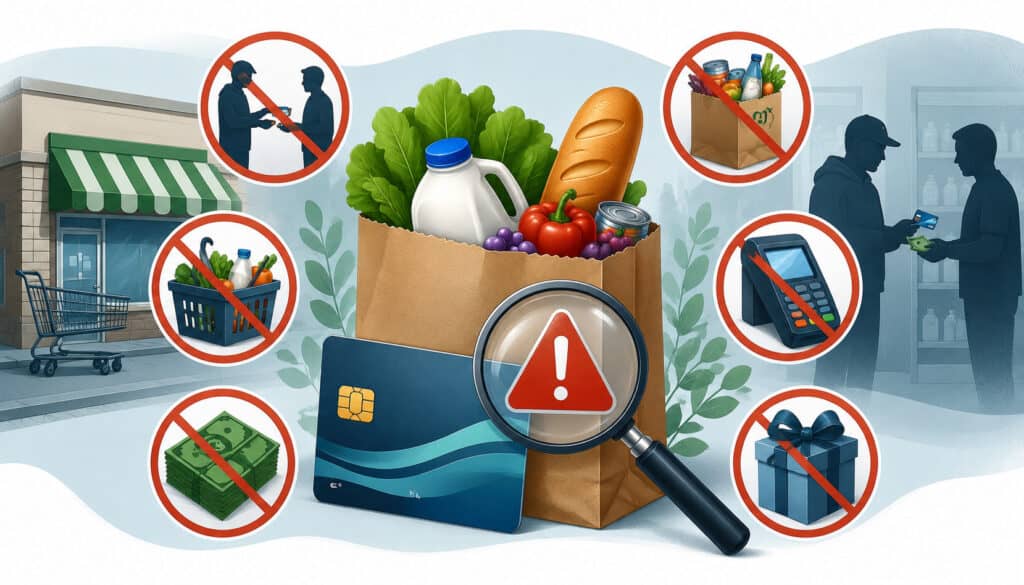
SNAP trafficking violations can take several forms. Some are obvious, such as exchanging benefits for cash. Others may be less obvious, such as allowing non-eligible products to be included in EBT purchases or processing inflated transactions that do not match actual eligible food sales.
Retailers should train staff to recognize both direct violations and risky behaviors. A customer request may sound casual, but employees need to know when the answer must be no. For example, a cashier should never provide cash back from SNAP benefits, exchange benefits for store credit, or manually adjust a sale to make ineligible items appear eligible.
| Violation Type | Example | Potential Compliance Risk |
| Cash exchange | Customer receives cash in return for an EBT transaction | High trafficking risk; possible permanent SNAP retailer disqualification |
| Ineligible item sale | SNAP benefits used for non-food items, alcohol, tobacco, hot prepared foods, or other prohibited products | SNAP compliance violations and possible penalties |
| Inflated transaction | Transaction amount is higher than the actual eligible food purchase | Suspicious data pattern and possible fraud concern |
| Fake transaction | Sale is processed without a real eligible food purchase | Serious trafficking allegation |
| Improper refund | Cash refund given for a SNAP purchase | EBT misuse violations and recordkeeping concern |
| Manual manipulation | Cashier manually enters amounts to bypass POS controls | SNAP transaction violations and weak internal control risk |
| Repeated suspicious patterns | Same card used repeatedly in short intervals for large or round-number purchases | May trigger SNAP investigation process |
Exchanging SNAP Benefits for Cash
Exchanging SNAP benefits for cash is one of the clearest forms of trafficking. The issue is simple: SNAP benefits are not cash. They are restricted benefits that may be used only for eligible food purchases through approved channels. A cashier, manager, or owner should never agree to run an EBT transaction and provide money back to the customer.
This includes partial cash exchanges, “discounted” cash exchanges, or arrangements where a customer receives cash, store credit, gift cards, or other value instead of eligible food. This type of violation can create severe SNAP retailer trafficking penalties. It may also expose the store to reputational harm, employee termination issues, and legal risk. Even one employee’s misconduct can damage the store’s authorization if management failed to supervise, train, or monitor activity.
Selling Non-Eligible Products Through SNAP Transactions
SNAP benefits may not be used for non-eligible items. Retailers must ensure that EBT transactions are limited to approved food items and that mixed baskets are handled correctly. When a cart includes both eligible and non-eligible products, the POS system should separate tender types so SNAP benefits apply only to eligible items.
Common risk areas include hot prepared foods, household goods, paper products, tobacco, alcohol, vitamins, supplements, medicine, pet food, and service fees. If a store uses a standalone terminal rather than an integrated POS, cashiers must be especially careful because the system may not automatically block ineligible items.
Misclassifying products in the POS can also create compliance exposure. A single incorrect SKU may seem minor, but repeated sales of ineligible items through SNAP can become a serious pattern. For additional cashier-focused guidance, retailers can review information for cashiers when accepting SNAP benefits.
Fake or Inflated Transactions
Fake or inflated transactions occur when the EBT amount does not reflect a real eligible food purchase. This may include processing a sale when no food was purchased, entering a higher amount than the actual eligible items, splitting transactions to disguise activity, or repeatedly entering round-number amounts.
These patterns can be especially risky because SNAP enforcement often relies on transaction data. A store’s sales history should make sense when compared with its size, inventory, customer traffic, business model, hours, and typical basket size. Retailers should monitor unusual patterns before an outside review occurs.
Look for repeated transactions at the same amount, unusually large EBT tickets, multiple transactions on the same card within a short period, excessive manual entries, or activity that does not match inventory movement.
How SNAP Trafficking Violations Are Detected
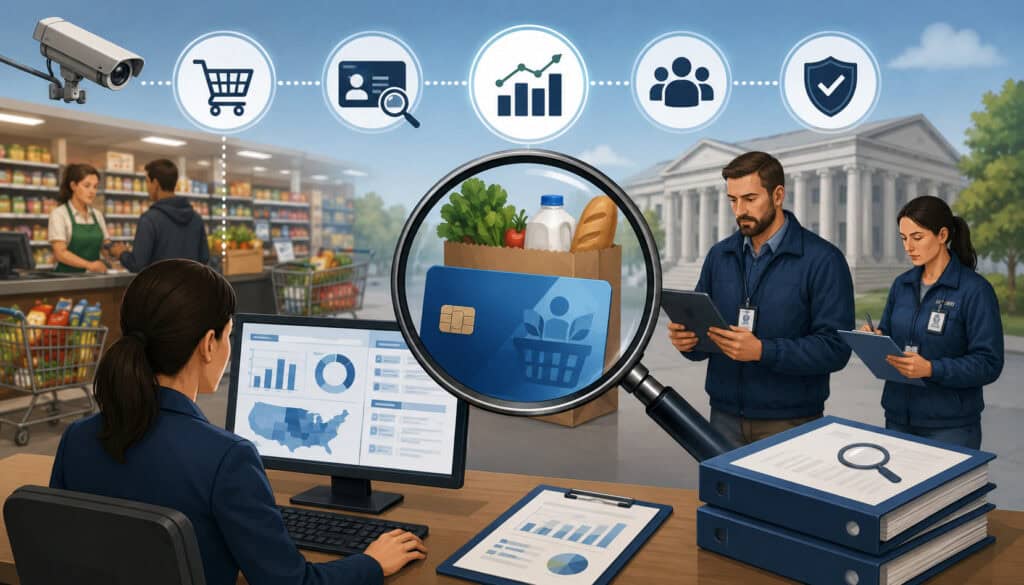
SNAP trafficking violations may be detected through transaction monitoring, EBT transaction analysis, audit reviews, customer complaints, undercover activity, inventory comparisons, and compliance investigations. Retailers should assume their EBT activity may be reviewed for consistency and reasonableness.
Transaction data can reveal patterns that are difficult to explain. For example, a very small store with limited eligible inventory may raise questions if it processes frequent large SNAP transactions. A store with many round-number EBT sales may appear to be running cash-equivalent transactions. A retailer with high SNAP sales but weak supplier invoices may struggle to show that it had enough eligible food inventory to support those redemptions.
Detection is not limited to intentional misconduct. Weak controls can create the same appearance as improper activity. For example, employees may process refunds incorrectly, manually override item categories, or fail to separate eligible and ineligible items. Over time, these mistakes can create data patterns that invite review.
USDA SNAP enforcement may involve records requests, transaction comparisons, store visits, and review of business operations. Organized documentation is one of the strongest ways to respond professionally.
Transaction Pattern Monitoring
Transaction pattern monitoring looks at how EBT sales behave over time. Reviewers may examine transaction size, timing, frequency, repeat card activity, refund behavior, manual entry activity, and comparisons with similar retailers. Patterns that may attract attention include:
- Repeated high-dollar EBT purchases
- Many transactions ending in exact round numbers
- Multiple transactions on the same card within minutes
- High refund or void activity
- EBT sales that appear inconsistent with store size
- Unusual activity during low-traffic hours
- Large purchases that do not match available inventory
Retailers can reduce risk by reviewing their own reports. Managers should know what normal activity looks like for their store. If a pattern changes, investigate it early. The explanation may be innocent, such as a holiday rush, new inventory, or a nearby competitor closing. Still, the store should document the reason when activity is unusual.
Inventory and Sales Reviews
Inventory reviews compare SNAP sales with the store’s actual food inventory. If a store claims high SNAP sales but has limited eligible food stock, missing invoices, or inconsistent supplier records, that mismatch can create compliance concerns. Retailers should keep supplier invoices, inventory logs, purchase records, delivery receipts, and POS sales reports.
These records help show that the store had enough eligible inventory to support legitimate SNAP sales. Inventory reviews may also consider store layout, shelf space, product categories, and business model.
A grocery store, convenience store, farm stand, or market vendor may have different operations, but each should be able to explain how eligible food sales are supported. Poor inventory tracking can make a legitimate store look risky. If records are scattered, incomplete, or unavailable, the retailer may struggle to respond during the SNAP investigation process.
Penalties for SNAP Trafficking Violations

SNAP retailer trafficking penalties can be serious. Depending on the facts, penalties may include warning letters, fines, temporary disqualification, permanent SNAP disqualification, civil money penalties, legal exposure, and reputational damage. Trafficking is treated as a high-severity violation.
Federal regulations allow permanent disqualification for trafficking, and civil money penalties in lieu of permanent disqualification are limited and require timely evidence of an effective compliance policy and program. Possible consequences may include:
- Warning letters for limited violations
- Temporary disqualification for certain compliance violations
- Permanent SNAP retailer disqualification for trafficking
- Civil money penalties in limited circumstances
- Loss of customer trust
- Processor or banking concerns
- Employee discipline or termination
- Legal expenses
- Operational disruption
The impact can extend beyond SNAP sales. A disqualification may affect store revenue, community reputation, and customer loyalty. It may also complicate future business changes, ownership transfers, or authorization applications. Retailers should take any charge letter, compliance notice, or records request seriously.
Deadlines may be short, and missing a response window can limit options. Because the stakes are high, merchants should gather records immediately and seek qualified guidance when facing allegations.
How Retailers Can Prevent SNAP Trafficking Violations
Preventing SNAP trafficking violations requires a practical compliance system. The goal is not to make daily operations complicated. The goal is to make correct behavior easy, consistent, and documented. A strong prevention program should include:
- Clear employee training
- Written SNAP transaction procedures
- POS controls that block ineligible items
- Manager review of refunds and voids
- Accurate inventory management
- Receipt and transaction record retention
- Secure user permissions
- Regular review of EBT reports
- Documented corrective action when mistakes happen
Prevention starts at checkout. Cashiers should understand eligible item rules, cash exchange prohibitions, mixed basket handling, refund procedures, and when to call a supervisor. Managers should review exceptions and investigate unusual patterns. POS systems also play a major role.
Integrated EBT-compatible POS systems can help categorize items, separate tender types, track transaction history, and reduce manual entry risk. However, technology is not enough. Retailers must maintain item files, update SKUs, and test system behavior after changes. For more operational risk examples, merchants can review common mistakes retailers make when handling EBT transactions.
Training Employees on SNAP Rules
Employee training is one of the most effective ways to prevent SNAP compliance violations. Cashiers are often the first line of defense because they handle customer questions, scan items, process payments, and manage exceptions. Training should explain what SNAP benefits can and cannot be used for.
It should also cover real scenarios, such as a customer asking for cash, trying to buy non-eligible items, requesting an improper refund, or asking the cashier to manually enter a different amount. Good training is repeated, documented, and role-specific. New hires need onboarding. Existing employees need refreshers.
Supervisors need deeper training on overrides, refunds, voids, reporting, and documentation. Retailers should keep records of training dates, attendees, topics covered, and employee acknowledgments. These records show that the store actively works to maintain SNAP retailer compliance.
Using POS Systems to Improve Compliance
EBT-compatible POS systems can help retailers reduce transaction mistakes and improve documentation. A properly configured POS can separate eligible and ineligible items, apply the correct tender, generate receipts, track refunds, and provide reports for internal review. The key phrase is “properly configured.”
A POS system only supports compliance if item files are accurate, employee permissions are controlled, refunds follow policy, and managers review exception activity. If a product is tagged incorrectly, the system may allow SNAP benefits to cover an ineligible item. Retailers should test POS behavior regularly.
Add new SKUs carefully. Review receipt formatting. Confirm that EBT refunds do not become cash-equivalent. Limit manual overrides to trained supervisors. A POS system can also support EBT fraud prevention by making unusual activity easier to identify. Reports can show large tickets, repeated transactions, cashier-level patterns, and refund trends.
SNAP Recordkeeping and Documentation Best Practices
Strong recordkeeping helps retailers prove that transactions were legitimate, inventory supported sales, and employees were trained. During a compliance review, organized records can reduce stress and improve response quality. Retailers should maintain:
- EBT transaction logs
- Receipts or electronic receipt records
- Refund and void records
- Supplier invoices
- Inventory records
- Settlement reports
- POS reports
- Employee schedules
- Training logs
- Policy acknowledgments
- Corrective action notes
- POS configuration records
- Digital backups
Documentation should be easy to locate. A retailer should not have to search through boxes, personal emails, or disconnected systems to answer basic compliance questions. Receipts are especially important because they help verify what was purchased, how payment was split, and whether the transaction matched store procedures.
Supplier invoices are also important because they help show that the store had eligible inventory to support SNAP sales. Digital backups can protect against lost paperwork. However, stores should also control access to sensitive records. Only authorized managers should adjust transaction records, refund logs, or POS settings.
Common Mistakes Retailers Should Avoid
Many SNAP compliance problems begin with everyday mistakes. A store may not intend to violate rules, but weak procedures can create risky transaction patterns. Common mistakes include:
- Not training new cashiers before they process EBT
- Allowing cashiers to decide eligibility without guidance
- Failing to update POS item categories
- Using manual entry too often
- Giving cash refunds for SNAP purchases
- Not reviewing refunds and voids
- Keeping poor supplier invoice records
- Ignoring unusual transaction reports
- Allowing shared cashier logins
- Not documenting corrective action
- Treating compliance as a one-time setup
Weak employee oversight is a major issue. If cashiers are not supervised, one employee can create repeated violations before management notices. Shared logins make this worse because the store cannot identify who processed a transaction. Poor recordkeeping is another common problem.
If inventory, receipts, and reports are incomplete, a retailer may be unable to explain legitimate transactions. That lack of documentation can make a compliance review more difficult. Improper refunds are also risky. SNAP refunds should follow program and processor rules. Cashiers should never turn a SNAP return into cash or store credit unless the procedure is clearly permitted under applicable rules.
What Happens During a SNAP Investigation?
The SNAP investigation process may involve transaction reviews, records requests, inventory verification, store visits, compliance interviews, and analysis of suspicious activity. Retailers should respond calmly, professionally, and with documentation.
A review may focus on a specific time period. The retailer may need to provide receipts, invoices, sales records, inventory documents, POS reports, refund logs, and employee information. Investigators may compare SNAP sales with inventory purchases, business size, customer traffic, and transaction behavior.
Retailers should avoid guessing. If a question is asked, answer based on records. If records need to be gathered, organize them carefully. If an issue is discovered internally, document what happened and what corrective action was taken. Ignoring a notice or responding casually can create more risk. Deadlines may matter. The store should preserve relevant records immediately, including POS data, receipts, invoices, schedules, and camera footage if available.
Preparing for Compliance Reviews
Preparation begins long before a notice arrives. Retailers should maintain records in a way that makes them easy to retrieve. A well-organized store can respond faster and more accurately. Managers should know where to find EBT reports, supplier invoices, refund logs, training records, and POS configuration details.
They should also understand the store’s normal transaction patterns, average ticket size, eligible inventory mix, and refund procedures. A mock review can be helpful. Pick a prior week and ask: Can we prove what we sold? Can we match EBT sales to receipts? Can we show eligible inventory? Can we explain refunds and voids? Can we identify which employee processed each transaction?
Responding Professionally to Compliance Questions
Professional communication matters during a compliance review. Retailers should be factual, organized, and respectful. Emotional responses, incomplete answers, or unsupported explanations may not help. When responding, provide documents in a clear order. Label files, match records to requested dates, and explain operational context where appropriate.
For example, if a period had unusually high sales because of seasonal demand, supplier changes, or nearby store closures, include supporting records. Retailers should also avoid altering records after the fact. If an error occurred, document the correction honestly. A clear corrective action plan may include retraining, POS updates, supervisor review, or revised refund procedures.
Best Practices for SNAP Compliance Management
SNAP retailer compliance works best when it is simple, repeatable, and assigned to specific people. Retailers should create a compliance routine that fits daily operations. Recommended practices include:
- Review EBT reports daily or weekly
- Audit inventory regularly
- Secure POS permissions
- Limit manual entry and overrides
- Document refunds clearly
- Train employees consistently
- Maintain supplier invoices
- Keep receipts accessible
- Monitor unusual transaction activity
- Test POS eligibility settings
- Review cashier-level exception reports
- Update policies when procedures change
Daily practices should focus on exceptions. Review refunds, voids, large EBT purchases, and manual entries. Weekly practices should focus on patterns. Look at average ticket size, repeated transactions, cashier activity, and inventory movement. Monthly practices should focus on documentation. Confirm invoices, reports, training records, and POS settings are complete.
Retailers should assign responsibility. If everyone is responsible, no one may actually review reports. A manager should own EBT compliance tasks and document completion. For a broader operational checklist, this EBT merchant requirements checklist may be useful for retailers reviewing authorization, setup, training, and documentation responsibilities.
FAQs About SNAP Trafficking Violations
What are SNAP trafficking violations?
SNAP trafficking violations involve improper exchange, sale, or misuse of SNAP benefits outside approved program rules.
What is considered EBT trafficking?
EBT trafficking includes cash exchanges, fake transactions, or unauthorized purchases using SNAP benefits.
How are SNAP trafficking violations detected?
Violations may be detected through audits, transaction monitoring, inventory reviews, and suspicious purchase patterns.
What penalties can retailers face?
Retailers may face warnings, fines, temporary penalties, or permanent SNAP disqualification.
Can POS systems help prevent violations?
Yes. POS systems help separate eligible items, track transactions, and improve SNAP compliance monitoring.
Why is employee training important?
Training helps employees avoid improper transactions and follow SNAP retailer compliance rules correctly.
What records should retailers keep?
Retailers should keep receipts, invoices, EBT transaction logs, refund reports, and inventory records.
How can merchants reduce compliance risks?
Merchants can reduce risks through training, secure POS systems, transaction monitoring, and organized records.
Conclusion
SNAP trafficking violations can create serious compliance, financial, and operational risks for retailers. A single weak area—poor training, inaccurate POS settings, incomplete records, improper refunds, or unusual transaction patterns—can create exposure during a review. The strongest protection is a practical compliance system. Train employees consistently. Use secure EBT-compatible POS controls. Keep organized receipts, invoices, and reports.
Monitor transactions proactively. Review inventory regularly. Document corrective actions when mistakes happen. Retailers that treat SNAP compliance as part of daily operations are better prepared to prevent EBT trafficking violations, respond to compliance questions, and protect their SNAP authorization.